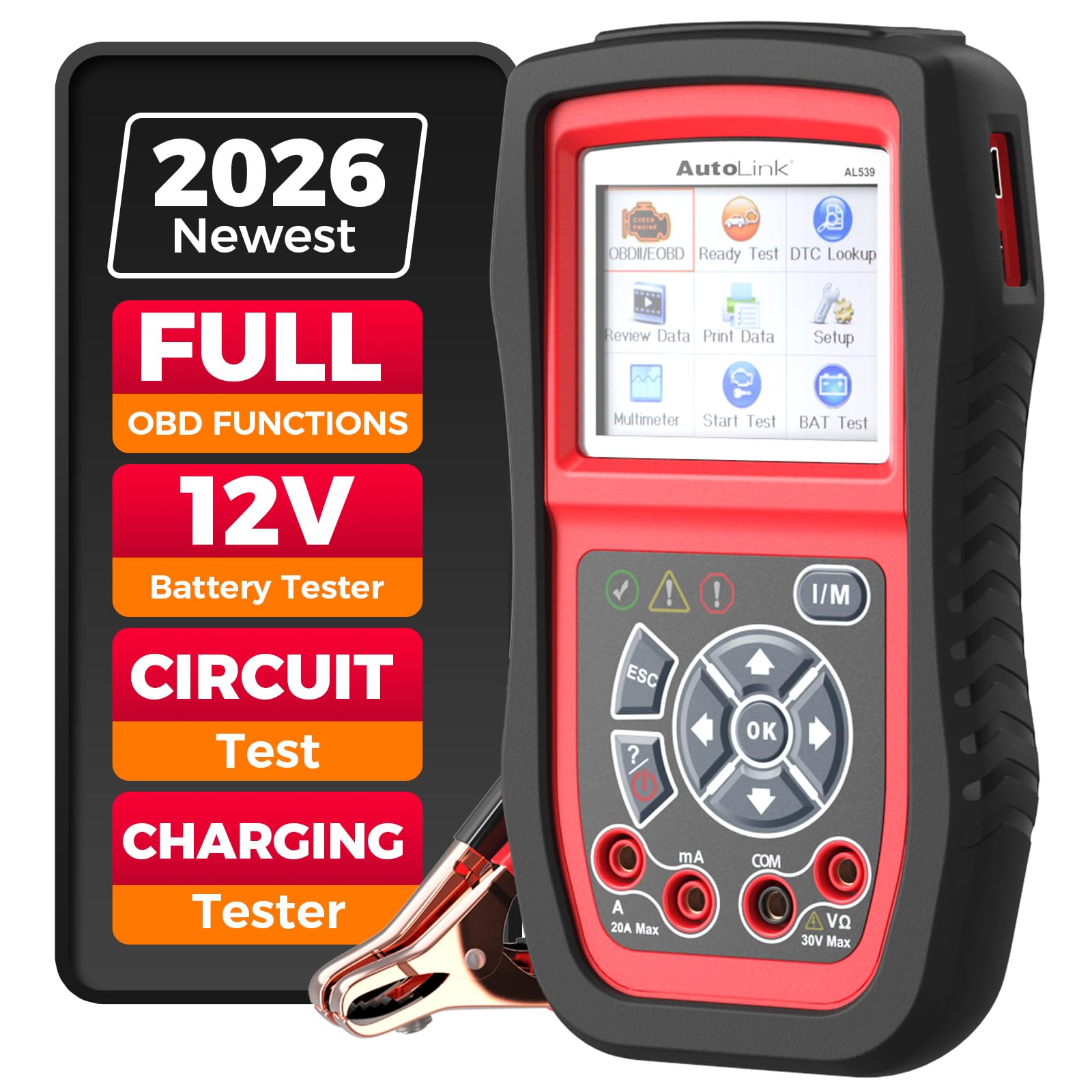
Autel AL539B OBD2 Scanner Battery Tester, 2.0 of AL519 AL539 Code Reader
Disclosure: We may earn a commission when you buy through links on this page, at no extra cost to you. As an Amazon Associate I earn from qualifying purchases. Learn more
Highlights
- 🚗3-in-1 OBD2 Scanner, Upgrade of AL519: Autel AL539B is not only a simple OBD2 code reader, but also a top-rated battery tester with AVOmeter. It is designed to work with most 1996 and newer American, Asian and European OBDII/CAN compliant vehicles, providing you with comprehensive vehicle analysis
- 🚗BATTERY TEST: AL539B, a expanded function OBD2 scanner with the additional capability of battery testing, is a great solution for you to quickly and accurately test most types of 12V batteries, including AGM, standard and maintenance-free batteries
- 🚗CIRCUIT TEST: Autel AL539B is not only equipped with an easy-to-read build-in AVOmeter to allow you to test voltage, continuity and current at the fingertip. It will be easy for you to quickly access information about voltage, continuity and current of any vehicle for battery status analysis
- 🚗Full OBD2 Functions: With AL539B OBD2 Scanner you can operate complete car diagnoses. Such as read/erase code, reade live date and freeze frame, I/M readiness status,O2 sensor test……The most direct and typical functions of this code scanner is to turn off the check engine light (MIL), which is completed via clearing the stored fault codes after the problems are solved
- 🚗FASTER DIAGNOSES: For faster and more convenient diagnosis, the Autel code reader AL539B supports DTC lookup for detailed codes information retrieval, data playback and print capability for convenient vehicle health status analyzing. Feel free to get technical support via emailer Q&A if you are unsure whether the scanner tool is suitable for your vehicle, or any questions
Why You'll Love It
- Combines vehicle diagnostics, 12V battery analysis, and electrical measurements in one handheld device
- Checks standard, AGM, and maintenance-free batteries to help assess battery condition
- Measures voltage, continuity, and current through its built-in AVOmeter
- Reads and clears diagnostic codes, displays live data, and retrieves freeze-frame information
- Includes DTC lookup, data playback, and printing capabilities for easier vehicle health analysis
Pros
- +Three diagnostic functions in one device
- +Supports several common 12V battery types
- +Full OBD2 diagnostic functions
- +Built-in AVOmeter for circuit measurements
- +DTC lookup and data playback
Cons
- -Battery analysis is limited to 12V batteries
- -Vehicle compatibility depends on OBDII/CAN compliance
Detailed Review
The AL539B OBD2 scanner is designed for vehicle owners who want more than a basic check engine light reader. Its main appeal is the combination of three functions: vehicle diagnostics, 12V battery analysis, and electrical measurements. Instead of focusing exclusively on retrieving engine fault codes, it brings several useful diagnostic capabilities together in one device. That makes it worth considering for owners who want to investigate vehicle warning lights while also keeping an eye on battery condition and electrical information.
Its vehicle diagnostic functions cover the core information many owners want to access when a warning light appears. The scanner can read and erase diagnostic trouble codes, display live data, retrieve freeze-frame information, check I/M readiness status, and perform O2 sensor checks. It can also turn off the check engine light by clearing stored fault codes after the underlying problems have been resolved. This distinction matters: clearing a code is part of the diagnostic process, not a replacement for addressing the issue that caused it.
The additional battery function gives this model a broader purpose. It supports battery analysis for most types of 12V batteries, including AGM, standard, and maintenance-free varieties. For someone who wants to monitor both engine-related diagnostic information and battery condition, having these functions in one scanner can make the device more useful across different vehicle maintenance situations. Its built-in AVOmeter adds another dimension by providing measurements of voltage, continuity, and current. These readings can help owners examine electrical information rather than relying only on stored vehicle fault codes.
There are also features intended to make diagnostic information easier to interpret and keep. DTC lookup provides detailed code information, while data playback gives users another way to review diagnostic information. Printing capability is included for people who prefer to retain vehicle health information for later reference. The combination makes the scanner relevant to both occasional vehicle owners and people who regularly work through diagnostic information. It is designed for most 1996 and newer American, Asian, and European vehicles that comply with OBDII/CAN requirements, so compatibility remains an important consideration before purchasing.
Verdict: This 3-in-1 scanner is a sensible option for vehicle owners who want OBD2 diagnostics alongside 12V battery analysis and basic electrical measurements. Its combination of code reading, live data, battery analysis, and AVOmeter functions gives it a broader role than a code reader alone. Buyers who need coverage beyond compatible OBDII/CAN vehicles or battery analysis beyond 12V applications should consider a different type of diagnostic equipment.
Who Should Buy It
A great fit if you:
- Own a compatible vehicle and want to investigate check engine warnings without relying exclusively on someone else to retrieve diagnostic codes.
- Prefer having battery condition information available alongside vehicle diagnostics instead of purchasing equipment for each function separately.
- Have a 12V AGM, standard, or maintenance-free battery and want access to additional battery analysis capabilities.
- Want to examine voltage, continuity, and current when looking into vehicle electrical information.
- Regularly review diagnostic information and would appreciate DTC lookup, data playback, and printing capabilities.
Consider something else if you:
- Need battery analysis for applications beyond 12V batteries and would benefit from a dedicated battery diagnostic device with broader coverage.
- Own a vehicle outside the stated OBDII/CAN compatibility and need a scanner designed specifically for that vehicle's diagnostic system.
Before You Buy
Confirm on the listing:
- Check your vehicle's model year, market, and diagnostic compatibility. The stated coverage is for most 1996 and newer American, Asian, and European OBDII/CAN compliant vehicles, rather than every vehicle without exception.
- Confirm that your battery is a supported 12V type. The listed battery coverage includes AGM, standard, and maintenance-free batteries.
- Review exactly what comes in the package, including any accessories or connections needed for the functions you intend to use.
- Check the instructions and support information for any requirements associated with using the AVOmeter, data playback, or printing features.
How to compare your options: Start by deciding whether you need only diagnostic code reading or also want battery analysis and electrical measurements. This model combines all three, with live data, freeze-frame information, I/M readiness, O2 sensor checks, and DTC lookup adding to its diagnostic coverage. If battery analysis is a priority, compare the supported battery types carefully. If electrical information matters more, pay attention to the available voltage, continuity, and current measurements. Finally, make vehicle compatibility your first purchasing check, since the listed coverage depends on OBDII/CAN compliance.
Getting the Most From It
Start by confirming that your vehicle is compatible with the scanner's OBDII/CAN coverage. Familiarize yourself with its available diagnostic functions before relying on individual readings. Knowing the difference between stored codes, live data, and freeze-frame information will help you make better use of the information presented.
When investigating a check engine warning, begin by retrieving the stored diagnostic codes and using the DTC lookup function to access additional code information. Review the available live data and freeze-frame details to help understand the diagnostic information. Avoid treating code clearing as a substitute for resolving the underlying problem.
Use the battery function when you want information about a supported 12V AGM, standard, or maintenance-free battery. The built-in AVOmeter also provides access to voltage, continuity, and current measurements. Choose the function that matches the information you are trying to examine rather than treating every reading as interchangeable.
Make use of data playback when you want to review diagnostic information, and consider the printing capability if keeping a vehicle health record would be useful. If instructions or technical support are needed, refer to the available product guidance and email or Q&A support. Keeping your diagnostic information organized can make subsequent vehicle checks easier to follow.
FAQ
What does the AL539B actually do?
It combines OBD2 vehicle diagnostics, 12V battery analysis, and AVOmeter electrical measurements. Its functions include reading and clearing codes, displaying live data, and measuring voltage, continuity, and current.
Will it work with my car?
It is designed for most 1996 and newer American, Asian, and European vehicles that comply with OBDII/CAN requirements. Check your vehicle's diagnostic compatibility before purchasing, since the coverage is not an unconditional fit for every vehicle.
Can it analyze AGM batteries?
Yes, AGM batteries are among its supported 12V battery types. Standard and maintenance-free 12V batteries are also included in the stated coverage.
Can it turn off the check engine light?
Yes, it can clear stored fault codes to turn off the check engine light after the underlying problems have been resolved. Clearing codes should not be confused with repairing the cause of a warning.
Does it include printing and code lookup?
Yes, DTC lookup, data playback, and printing capability are listed features. These functions provide additional ways to understand, review, and retain vehicle diagnostic information.
Product Details
| ASIN | B079GXRV1M |