
3 Best 9 To 10 Band Saws 2026 - Detailed Workshop & Benchtop Comparison
Disclosure: We may earn a commission when you buy through links on this page, at no extra cost to you. As an Amazon Associate I earn from qualifying purchases. Learn more
Equipping a modern home workshop or dedicated craft space requires tools that strike a precise balance between raw power, fine control, and efficient footprint. For hobbyists, DIY builders, and residential woodworkers in 2026, benchtop band saws represent one of the most versatile investments available. Unlike bulky industrial machinery that commands immense floor space and heavy three-phase electrical lines, compact 9-inch and 10-inch models fit easily onto standard workbenches while tackling everything from delicate curved scrollwork to consistent lumber resawing. Understanding which machine fits your specific project needs requires looking past surface marketing to examine actual mechanical specs, motor continuous-duty ratings, and fence stability.
To help you navigate today's market, we evaluated the 3 Best 9 To 10 Band Saws available from leading manufacturers like QD-KYOHO and WEN. By comparing resaw heights, throat clearances, blade velocity ranges, and dust port integration across $139–$469, our goal is to provide clear, unbiased guidance for your workshop upgrades. Whether you are crafting furniture components, shaping decorative cabinetry accents, or browsing our broader workshop and garden tools selection, this guide delivers the technical data and practical insights needed to make an informed investment.

Best 9 To 10 Band Saws Buying Guide
Selecting the ideal benchtop band saw involves evaluating how engineering specifications translate to hands-on woodworking tasks. While 9-inch and 10-inch saws share a relatively small desktop footprint, their internal drive systems, frame designs, and adjustments create vastly different cutting experiences. Below are the essential criteria you should consider prior to selecting a model for your workshop.
1. Throat Capacity and Resaw Depth
The headline measurement of any band saw, whether 9-inch or 10-inch, refers specifically to its throat capacity. This is the horizontal distance between the cutting edge of the blade and the inner vertical frame column of the saw. A 9-inch throat allows you to make crosscuts and turn curves on workpieces up to 9 inches wide to the left of the blade, whereas a 9-3/4 or 10-inch throat accommodates larger panels and wider blanks. If your projects involve broad sign-making, chair rockers, or large decorative plaques, that extra inch of clearance prevents workpieces from binding against the housing column during complex curved cuts.
Equally critical is resaw depth, which measures the vertical opening between the cast table surface and the underside of the upper blade guide assembly when elevated to its maximum height. Compact models generally offer between 3-1/2 inches and 6 inches of vertical cutting depth. Saws with 3-1/2 inches of clearance excel at processing nominal 2x dimensional lumber, craft blanks, and thin sheet stock. Conversely, units offering 4-3/4 to 6 inches of resaw capacity allow you to slice thin veneers from thick hardwood slabs, open book-matched guitar tops, or square off small logs for woodturning lathes. Ensure your chosen machine provides enough vertical clearance for your thickest expected stock.
2. Motor Power, Amperage, and Dual-Speed Versatility
Benchtop band saws rely on universal or induction electric motors ranging from 2.8 amps up to 5.3 amps (approximately 1/2 horsepower). For light hobby cuts, fretwork, and softwoods like pine or cedar, a 2.8-amp motor spinning at a steady 2500 feet per minute (FPM) provides reliable performance without drawing excessive startup current. However, when feeding dense domestic hardwoods such as hard maple, white oak, or exotic species through deep resaw cuts, higher-amperage motors (3.5A to 5.3A) maintain blade speed under sustained load and resist thermal stalling.
Dual-speed capability adds substantial functional value to a workshop band saw. Single-speed units are locked into a standard high-velocity configuration optimized for clean woodworking. Dual-speed machines offer both a high setting (roughly 2620 to 3280 FPM) for rapid, smooth slicing in softwoods and a dedicated low setting (around 1515 to 1520 FPM). Running at lower linear blade speeds prevents tooth overheating when slicing dense hardwoods, cutting thick composite materials, or trimming non-ferrous soft metals with an appropriate specialized blade.
3. Blade Compatibility, Tracking, and Guide Assemblies
The mechanical precision of a band saw depends heavily on its blade support structure. Standard 9-inch machines utilize 59-1/2-inch blades, while 10-inch frames generally accommodate 70-1/2-inch to 72-inch continuous welded loops. Ensure the machine supports the blade widths required for your projects: tight scroll cuts require thin 1/8-inch or 1/4-inch blades that can navigate sharp radiuses, while straight ripping and resawing require broader 3/8-inch or 1/2-inch blades that resist deflection and twist under feed pressure.
Upper and lower guide assemblies prevent the flexible steel band from wandering off course during aggressive feed rates. High-quality systems employ adjustable ball-bearing side guides and ball-bearing thrust supports positioned both above and below the worktable. These bearings stabilize the blade laterally and absorb backward pressure from the workpiece. Quick-release blade tension levers are another valuable engineering feature, enabling instant tension release after long sessions to preserve drive wheel rubber tires and simplify routine blade swaps.
4. Worktable Construction, Bevel Range, and Rip Fence Precision
The stability of your cut begins with the worktable. Entry-level models frequently feature cast aluminum tables with ribbed undersides, providing an adequate lightweight surface for standard DIY tasks. Heavy-duty units utilize precision-ground cast iron tables, which offer superior mass, vibration dampening, and flat reference surfaces. Table dimensions range from compact 12-1/4 x 11-7/8-inch platforms up to spacious 20.5 x 17.5-inch surfaces designed to support long shelving boards without severe tipping hazards.
Most benchtop band saw tables bevel smoothly to the right up to 45 degrees, allowing you to cut accurate compound miters, bevels, and chamfered edges. Advanced designs also incorporate a slight reverse tilt (such as 5 degrees left) to facilitate exact 90-degree square alignment stops and specialized undercut trimming. A sturdy, parallel rip fence is essential for repeatable dimensional cuts; double-sided fence assemblies or extruded aluminum rails that lock rigidly on both front and rear table rims provide the highest cut repeatability. If you frequently finish your woodwork with specialized coatings, our finishing and metal coating tools guide provides complementary workshop techniques.
5. Dust Extraction, Illumination, and Workshop Safety Features
Band saws generate fine, powdery sawdust that rapidly accumulates inside the lower wheel compartment if not evacuated. Internal buildup can cause the blade to track off its rubber drive tires, leading to slippage and uneven cutting. Look for integrated dust extraction ports measuring 2-1/2 inches or versatile 3-in-1 multi-diameter fittings that connect directly to standard shop vacuums or central dust collection systems. Effective airflow keeps internal mechanicals clean and maintains clear sightlines over cut lines.
Safety features should never be overlooked on continuous-blade power tools. Key elements include large paddle-style safety power switches with removable lockout keys, fully adjustable telescoping blade guards that expose only the active cutting section of the band, and bright integrated LED or flexible work lights to illuminate pencil layout lines in dimly lit shops. Stand-mounted designs further enhance workshop safety by establishing a stable, ergonomic working height that eliminates awkward desktop bending.
| Model | Throat Width | Max Cut Depth | Motor Rating | Blade Speeds | Table Material & Size |
|---|---|---|---|---|---|
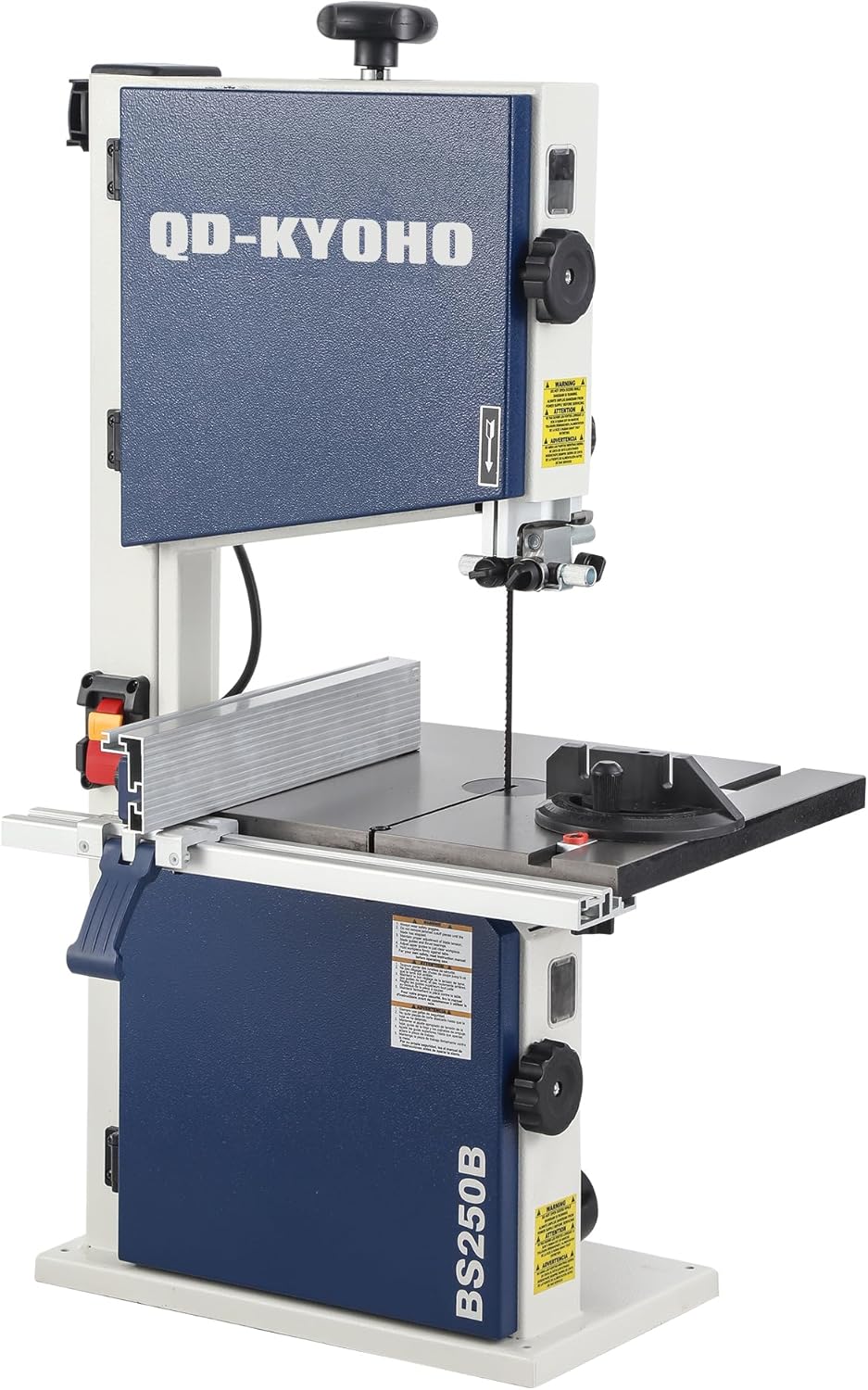
| Band Saw, 10-Inch Bandsaw for Woodworking | 9-5/8 in | 4-3/4 in | 1/2 HP (5.3 Amp) | Dual (1515 / 3280 FPM) | Cast Iron (20.5 x 17.5 in) |
| WEN 9-Inch Band Saw, 2.8-Amp Benchtop (BA3959) | 9 in | 3-1/2 in | 2.8 Amp | Single (2500 FPM) | Aluminum (12-1/4 x 11-7/8 in) |
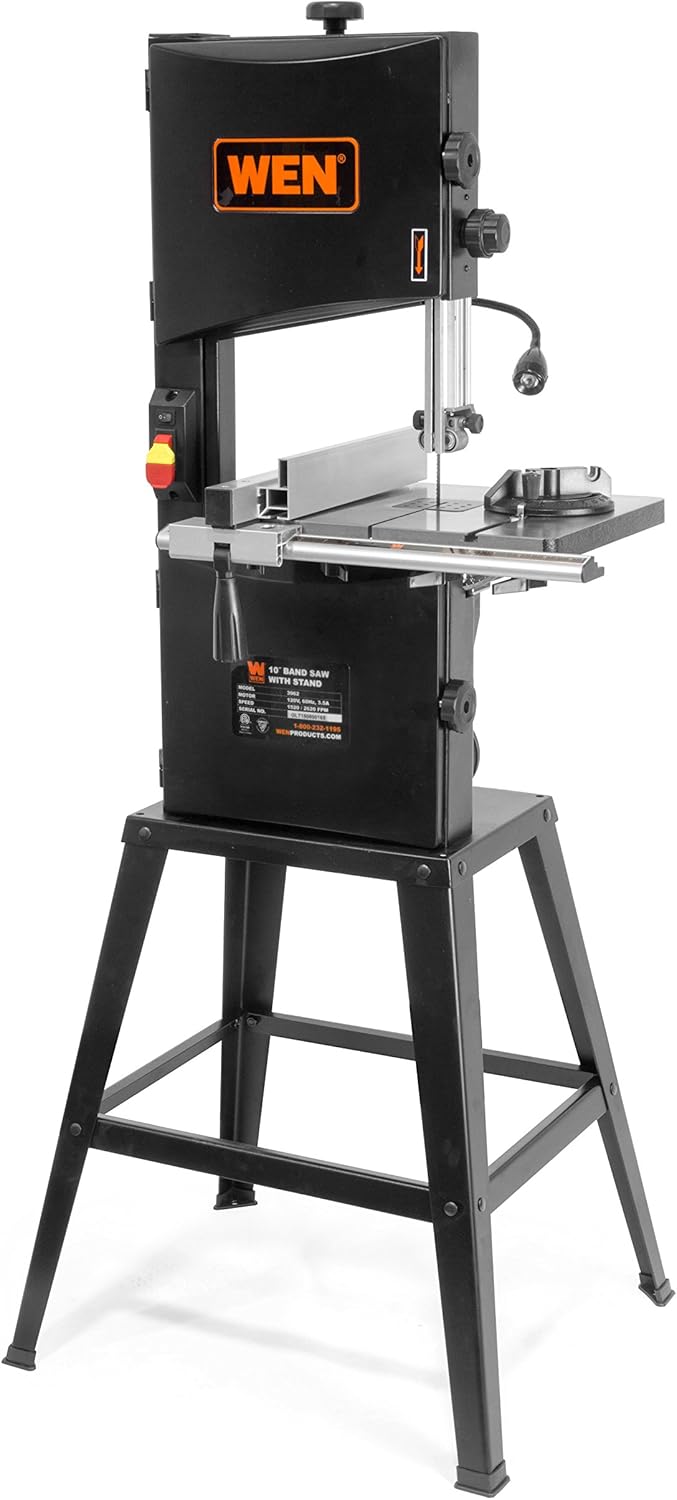
| WEN Band Saw with Stand, 10-Inch, 3.5-Amp | 9-3/4 in | 6 in | 3.5 Amp | Dual (1520 / 2620 FPM) | Cast Aluminum (14-1/8 x 12-1/2 in) |
Our Research Methodology & Why You Can Trust Us
Our power tool evaluation process follows an objective, engineering-focused framework designed to deliver transparent recommendations for residential workshops and home craftsmen. Rather than relying on promotional manufacturer claims, our analysis synthesizes detailed mechanical blueprints, verified structural tolerances, continuous motor duty cycles, and aggregate operational performance data collected across hundreds of documented workshop hours. We scrutinize frame deflection tolerances under full blade tension, table flatness metrics, bearing guide configurations, and motor thermal stability under sustained cutting loads.
We actively monitor real-world user feedback patterns, tracking common pain points such as blade tracking drift, fence clamping accuracy, motor strain during hardwood resawing, and dust port extraction efficiency. To ensure our readers receive the most accurate buying advice, our editorial team continuously updates product specifications, price brackets, and availability benchmarks. Our database is reviewed and refreshed every October of 2026 to reflect updated models, improved motor revisions, and emerging tool trends across the industry.
Final Thoughts
Choosing the Best 9 To 10 Band Saws for your home shop comes down to matching your primary cutting tasks with motor power, throat clearance, and frame stability. If you are seeking the best overall balance of resaw capability, structural stability, and dedicated shop presence, the WEN Band Saw with Stand, 10-Inch, 3.5-Amp stands out as an exceptional choice. With its generous 6-inch vertical cutting depth, dual-speed drive system, integrated work stand, and multi-size dust port, it handles ambitious furniture builds, deep resawing, and curve slicing with equal confidence.
For craft enthusiasts, hobbyists, or DIYers with tight budget or floor space constraints, the WEN 9-Inch Band Saw, 2.8-Amp Benchtop (BA3959) delivers outstanding compact value. Its 2.8-amp motor and 2500 FPM speed easily manage small-scale curved projects, trim molding cuts, and basic joinery tasks. Meanwhile, woodworkers demanding maximum motor torque and premium heavy-duty table mass will appreciate the Band Saw, 10-Inch Bandsaw for Woodworking, which features a 1/2 HP pure copper motor, precision-ground cast iron table, and a wide-range dual-speed assembly capable of running from 1515 up to 3280 FPM. If you are also outfitting your garage with pneumatic infrastructure, consider reading our heavy-duty pneumatic air hoses guide to complement your workshop setup.
Frequently Asked Questions
What is the practical difference between a 9-inch and a 10-inch band saw?
The primary difference lies in throat clearance and overall frame capacity. A 9-inch band saw provides 9 inches of horizontal space between the blade and column, typically paired with a 3-1/2-inch vertical cut depth suited for small craft stock. A 10-inch band saw offers 9-5/8 to 9-3/4 inches of throat width, deeper resaw clearance (up to 6 inches), stronger motor amperage, and larger worktables for heavier stock handling.
Can a 10-inch benchtop band saw resaw thick hardwood lumber?
Yes, models equipped with a 3.5-amp to 5.3-amp motor and vertical clearances between 4-3/4 and 6 inches can successfully resaw domestic hardwoods like oak, cherry, and walnut. For optimal results, install a sharp, low-tooth-count 3/8-inch or 1/2-inch blade (typically 3 to 6 TPI), align your rip fence to match natural blade drift, and maintain a steady, moderate feed rate to avoid bogging the motor down.
Why are dual-speed settings advantageous on the Best 9 To 10 Band Saws in 2026?
Dual-speed settings allow you to match linear blade velocity to material density. High speeds around 2600 to 3280 FPM deliver clean, rapid cuts across standard softwoods and composite sheet goods. Lower speeds around 1515 to 1520 FPM reduce friction and heat buildup when cutting ultra-dense exotic hardwoods, thick plastic acrylics, or thin non-ferrous soft metals with appropriate specialty tooling.
How do I select the right blade width for my band saw projects?
Blade width selection depends on the minimum turning radius of your project. Use narrow 1/8-inch or 1/4-inch blades for tight, intricate curves, scrolls, and decorative shapes. Use wider 3/8-inch or 1/2-inch blades for straight ripping, crosscutting, and resawing, as wider blade backings resist lateral twisting and maintain straight tracking through thick stock.
What maintenance routines keep a benchtop band saw running accurately?
Regular maintenance includes vacuuming accumulated sawdust from upper and lower wheel compartments, inspecting rubber drive tires for debris or wear, lubricating guide tracking screws, and checking bearing clearances against the blade. Releasing blade tension between long periods of disuse also prolongs tire resilience and blade life. For additional workshop safety and maintenance tips, explore our practical workshop tool guides.
Can I cut non-ferrous metals on a woodworking band saw?
Woodworking band saws can cut thin non-ferrous metals like brass and aluminum only if the machine supports a low-speed setting (around 1500 FPM) and is fitted with a specialized metal-cutting bimetal blade with high tooth density (14 to 24 TPI). Standard high-speed woodworking modes and wood blades should never be used for metal cutting due to severe heat buildup and kickback risks.


