
Best AstroAI Multimeter in 2026: How to Pick From the Lineup
Disclosure: We may earn a commission when you buy through links on this page, at no extra cost to you. As an Amazon Associate I earn from qualifying purchases. Learn more

Choosing the best AstroAI multimeter means matching value to your tasks. Compare meter classes, clamp options, accuracy and safety listings.
AstroAI built its name by selling capable meters at prices that make trade brands look steep. The lineup leans toward car owners, students, and homeowners, with auto ranging models, generous accessory kits, and even a clamp meter at friendly prices. Finding the best astroai multimeter for you means separating the genuine value in this range from the places where a low price still asks for caution.
This guide explains how the AstroAI range is organized, which specs to verify before buying, and where these meters fit honestly next to trade tools. The comparison table below shows the main classes, and the guidance after it helps you choose with open eyes.






Who Should Buy an AstroAI Multimeter?
Car Owners Diagnosing Batteries and Charging Systems
This brand speaks directly to driveway work, and several models bundle the extras vehicle testing wants: long leads, alligator clips, and clear DC ranges. Battery voltage, alternator output, fuse checks, and basic sensor voltage all sit comfortably within these meters. Owners planning deeper diagnosis can compare against our dedicated guide to the best multimeter for automotive work to see what specialist features add.
Students and Hobbyists Stocking a First Bench
When every dollar competes with components and tools, a meter that covers voltage, resistance, continuity, diode test, and transistor checks in one box is hard to argue with. AstroAI kits often include the small accessories beginners forget to buy, like spare leads and a carrying case. The learning value is real: you can make your beginner mistakes, including the classic blown fuse, on a meter that does not hurt to replace.
Homeowners Who Check a Few Things a Year
If your meter lives in a drawer and comes out for outlet checks, battery sorting, and the odd appliance fuse, paying trade prices buys durability you may never use. A listed model from this range covers those jobs with money left over. Our guide to the best multimeter for home use helps you judge where your own usage truly sits before you decide how far up to shop.
Key Features to Compare
How the AstroAI Range Is Organized
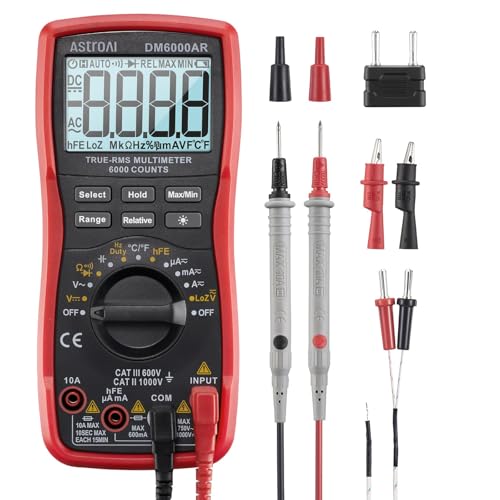
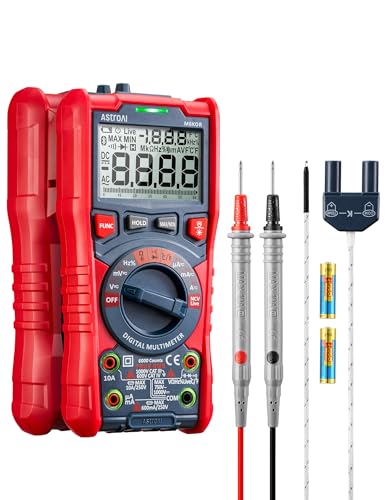
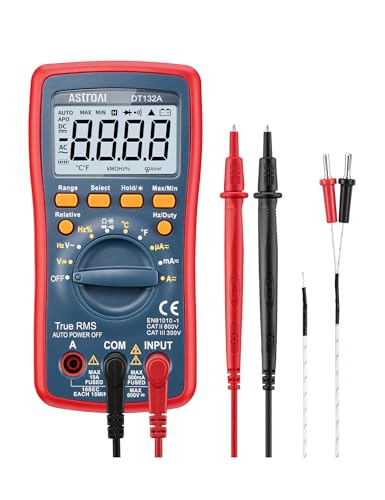
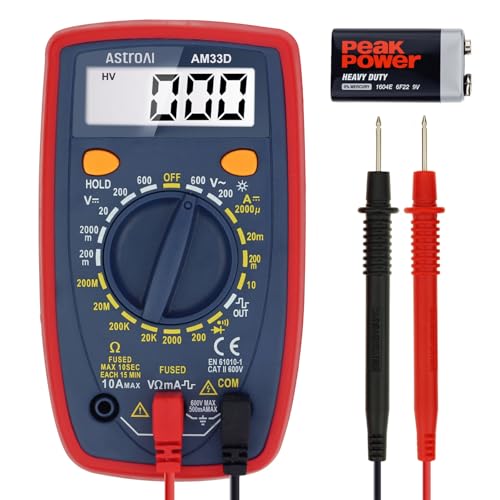
The lineup centers on a few handheld classes: compact manual ranging meters at the lowest prices, auto ranging models with more functions in the middle, and a clamp meter for current work. Prices run roughly from about $10 to $40, which is the entire appeal. Within that span, spend toward the top if you can; the better displays, faster continuity, and sturdier leads cluster there, and the difference in daily feel is larger than the difference in price.
Auto Ranging and Display Quality
Most AstroAI models worth buying are auto ranging, which suits owners who measure occasionally and do not want to think about dial ranges. Displays in the middle of the range reach 6000 counts with a backlight, a genuine step up from the 2000 count screens at the bottom. Check the sampling speed in the specs if you can find it; slow meters make hunting an intermittent connection frustrating, because the number arrives after the moment has passed.
Safety Ratings: Verify, Do Not Assume
This is the section that matters most with any value brand. AstroAI lists CAT ratings on its meters, and some models carry third party marks, but the coverage is not uniform across the range. Before buying, confirm the exact rating and look for an independent listing such as ETL or UL on the product page and the meter itself. Keep a value meter at outlets and low energy circuits, and leave panel interiors to higher rated trade tools regardless of brand.
Accuracy Expectations at This Price
Stated accuracy on these meters is honest for home and auto work, typically around half a percent to one percent on DC voltage. That is plenty for battery health, charging voltage, and sensor plausibility checks. It is not lab grade, and readings at the extremes of a range deserve a grain of salt. The practical test is consistency: a meter that repeats the same number on the same source every time is doing its job, whatever the badge.
Accessory Kits and Lead Quality
AstroAI often wins the unboxing: cases, spare fuses, extra probe tips, and alligator clips appear in kits that cost less than a trade brand lead set alone. Enjoy the value, but inspect the leads with the same suspicion you would apply anywhere. Flex them, check the strain reliefs, and confirm the plug fit is snug. If the leads feel like the weak point, a better lead set is the smartest upgrade and still keeps the whole kit inexpensive.
Clamp Meter Option in the Range
The brand clamp meter adds current measurement without breaking a circuit, aimed at car draw tests and household appliance checks. Clamp accuracy at this price is coarse at low currents, so treat small readings as estimates. For alternator output and motor draw, where currents are larger, it is genuinely useful. Buyers weighing clamp against handheld formats can step back to our guide to the best multimeter types overall for the wider picture.
Where AstroAI Fits Against Trade Brands
The honest summary is that AstroAI sells measurement capability cheaply and trade durability dearly elsewhere. You give up the deepest safety engineering, the longest warranties, and calibration support, and in exchange you get features years earlier in your budget. For low energy home, auto, and hobby work, that trade is rational. For daily panel work, it is not, which is why our guide to the best multimeter for electricians points at different shelves entirely.
Support is the other quiet difference. Expect email based help and replacement rather than a service network, and expect model refreshes that change specs quietly. None of that makes the meters bad; it makes them consumables with a long fuse. Buy with that mindset, verify the listing marks, and the value proposition holds up well.
Common Mistakes to Avoid
- Trusting a printed CAT rating on the cheapest model without checking for an independent listing mark.
- Using a value meter inside a breaker panel because it worked fine at outlets.
- Expecting lab accuracy at the far ends of each range, then doubting healthy car parts.
- Ignoring lead quality because the kit looked generous in the listing photos.
- Buying the absolute cheapest model when the mid range one adds a backlight and faster continuity for a few dollars.
- Assuming every model in the range shares the same specs, since refreshes change details quietly.
How to Make Your AstroAI Multimeter Last Longer
Value meters reward gentle handling more than trade tools do. Keep yours in the included case, out of the trunk temperature swings that age batteries and displays. Wind the leads loosely, and store the meter with the dial off so a bump in the drawer does not wake it in a current mode with probes touching metal.
Check the fuse after any session where current readings suddenly read zero, and keep the spare that many kits include taped inside the case. Wipe the screen with a soft cloth only, because budget plastics scratch and cloud faster than trade grade lenses. When the low battery indicator shows, swap the battery soon; dim displays and drifting readings on these meters often trace back to a tired cell rather than a dying meter.
Frequently Asked Questions
Is AstroAI a good multimeter brand for beginners?
For beginners, yes, with the safety caveat covered above. The meters are affordable, auto ranging models are forgiving to learn on, and the kits include the small parts new owners forget. The brand suits learning, home, and car work at low energy levels. Choose a model with a verified listing mark, learn the live dead live habit early, and the meter will teach you plenty before you outgrow it.
Which AstroAI multimeter class suits car battery testing?
Any mid range auto ranging model with a clear DC voltage range and a fast display covers battery and charging checks well. Resting voltage around 12.6 volts, cranking dips, and alternator output near 14 volts are all coarse readings that do not strain these meters. Add the clamp model only if you plan parasitic draw hunts, and remember that small draw readings from a budget clamp are estimates, not verdicts.
Are AstroAI multimeters accurate enough for electronics projects?
For hobby electronics, generally yes. Power supply rails, logic levels, resistor values, and continuity are all forgiving measurements. Where you should be careful is precision analog work and very low resistance, where lead resistance and basic accuracy blur the answer. Null the leads with relative mode if your model offers it, keep expectations matched to the price, and the meter will serve a hobby bench respectably.
How long does an AstroAI multimeter typically last?
With drawer storage and occasional use, several years is a fair expectation, and the leads or battery usually age out before the electronics do. Heavy daily use shortens that, because dials and jacks on value meters are not built to trade cycle counts. Treat it as a long lived consumable: when the dial grows intermittent or the case cracks, replacement is the economical answer rather than repair.
What should you check first when an AstroAI meter gives odd readings?
Check the battery first, then the leads, then the jack positions, in that order. A weak battery quietly corrupts readings on budget meters, and a lead in the current jack makes voltage tests read nonsense. Touch the probes together on continuity to confirm the leads, and measure a fresh battery as a known source. Most odd readings surrender to those four checks in under a minute.
Final Thoughts
AstroAI proves that a useful meter does not need a trade price, as long as you verify the safety listing, respect the energy limits, and judge accuracy by home and auto standards. For students, car owners, and drawer duty homeowners, the best astroai multimeter is the mid range auto ranging model with the best leads in the kit. Compare the classes in the product table above and spend the small step up; it is the best value move in the whole lineup.


