
Best 6 Gallon Air Compressor in 2026: The Middle Size That Covers Most Home Jobs
Disclosure: We may earn a commission when you buy through links on this page, at no extra cost to you. As an Amazon Associate I earn from qualifying purchases. Learn more

Compare the best 6 gallon air compressor specs that matter: airflow at 90 PSI, recovery time, noise, weight and what tools this tank size can really run.
Six gallons is the tank size you end up with after the tiny inflator proves too weak and the big shop compressor proves too heavy to move. It runs brad nailers all afternoon, tops up car tires without complaint, and still lifts with one hand. Picking the best 6 gallon air compressor is less about the tank, which is the same size across brands, and more about how fast the pump refills it and how the machine behaves in your space.
This guide focuses on the specs that separate a good 6 gallon unit from a frustrating one: airflow, recovery time, noise, and build details you only notice after a month of use. If you are still deciding between tank sizes altogether, our broader guide to the best air compressor covers the full range. The comparison table below puts the headline numbers for this size class in one place.



Who Should Buy Which 6 Gallon Air Compressor?
Trim, Furniture, and Hobby Woodworkers
Nail guns sip air in short bursts, which is exactly what a 6 gallon tank serves well. You can run a brad nailer, a finish nailer, or a pin nailer for hours of trim work, cabinet assembly, and picture frame projects. Look for a model with two couplers if a helper sometimes shoots a second gun, and a low, stable stance that resists tipping when you tug the hose. This group gets the most from the size and rarely outgrows it.
Homeowners Handling Tires, Inflatables, and Cleanup
For the weekly round of car tires, bike tires, pool toys, and blowing dust off a workbench, almost any healthy 6 gallon unit does the job. Your priorities are simple controls, a readable gauge, and a drain valve you can reach without tipping the machine. If the compressor will live in the garage full time, our guide to the best air compressor for home garage adds sizing advice for larger garage tools you might add later.
Mobile Users Who Carry the Compressor to the Job
Installers and handypeople who move between rooms or houses care about the carry handle and the cord wrap as much as the pump. A pancake shape rides flat in a vehicle and stacks with toolboxes, while rubber feet keep it from walking across a finished floor. Weight matters here: most 6 gallon models land near 30 pounds, and a few pounds saved is noticeable on the third trip up a staircase.
Key Features to Compare
Airflow in SCFM at 90 PSI
Airflow, listed as SCFM or CFM at 90 PSI, is the number that decides which tools the compressor can feed. Most 6 gallon models deliver about 2.5 to 3 SCFM at 90 PSI, which covers nail guns, staplers, and inflators with room to spare. Tools that spin continuously, like die grinders and sanders, want 4 SCFM or more and will outrun this tank size. Read the rating at 90 PSI, not the higher figure quoted at 40 PSI, because the 90 PSI number is the one your nailer actually sees.
Maximum Pressure and Recovery Time
A higher maximum pressure, usually 150 to 165 PSI, stores more usable air in the same 6 gallon tank, so the motor starts less often during nailing. Recovery time, how long the pump takes to climb from cut in to cut out pressure, matters just as much. A unit that recovers in about 30 to 45 seconds keeps pace when you are setting nails every few seconds along a baseboard run. Slow recovery is the most common complaint about cheap models, and it shows up exactly when the job gets repetitive.
Oil Free Versus Oil Lubed Pump
Nearly every 6 gallon compressor is oil free, which means no oil changes, no checking a sight glass, and no worry about running the machine on a slope or tipping it in the car. The trade is noise and, over many years, pump life, since oil lubed pumps generally run quieter and cooler. For the intermittent use this size is built for, oil free is the sensible default. If your work means the pump runs for long stretches daily, step up to a larger oil lubed model instead of forcing this class to do it.
Noise Level in Decibels
Standard pancake models run around 75 to 82 decibels, loud enough that conversation stops while the pump cycles. Quiet designs with low RPM motors drop that to roughly 60 to 70 decibels, which lets you work in an occupied house or a basement shop without rattling the floor above. The tank size is identical; you pay for the motor and pump design. If the compressor will run indoors near living space, treat the decibel rating as a headline spec rather than a footnote.
Tank Shape, Weight, and Feet
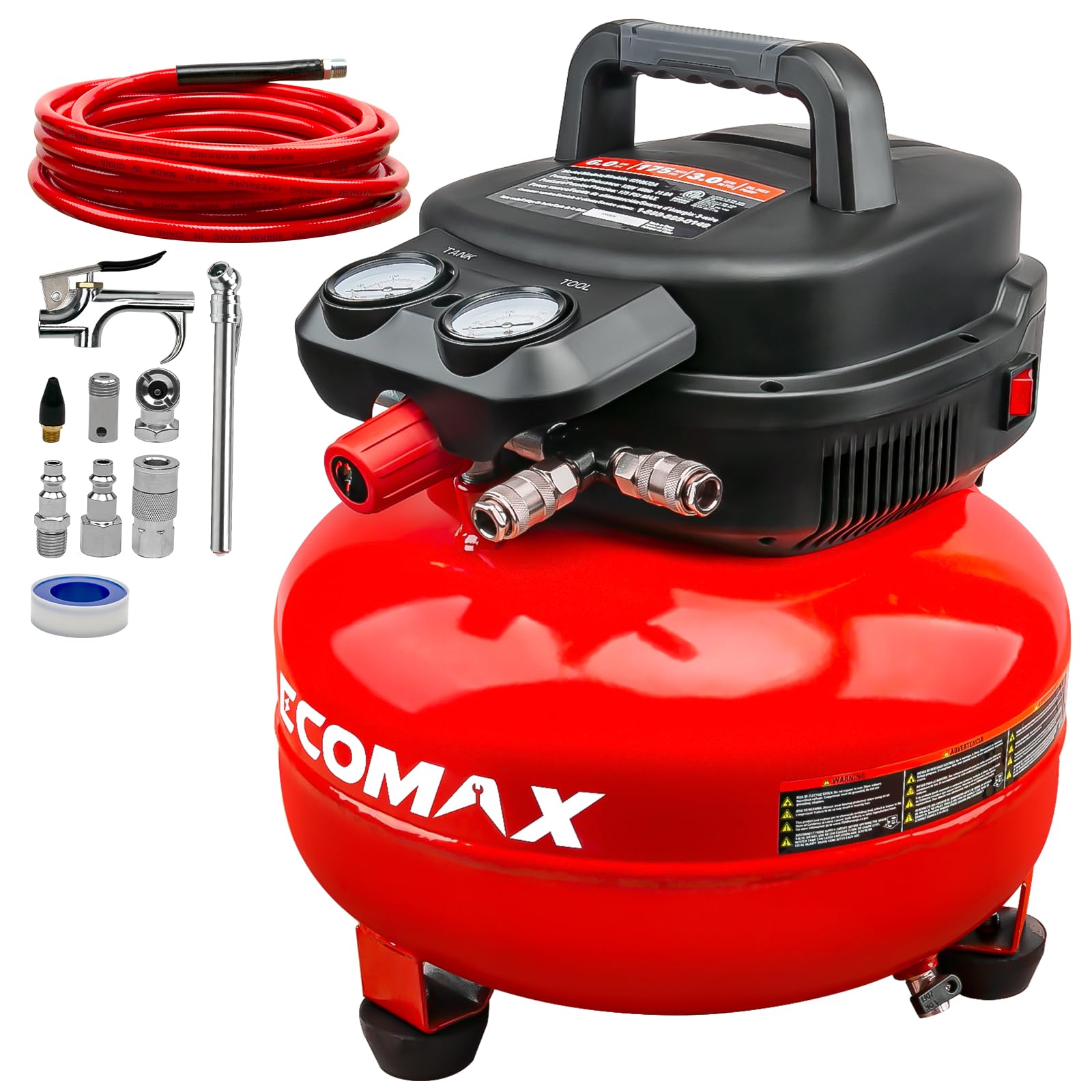
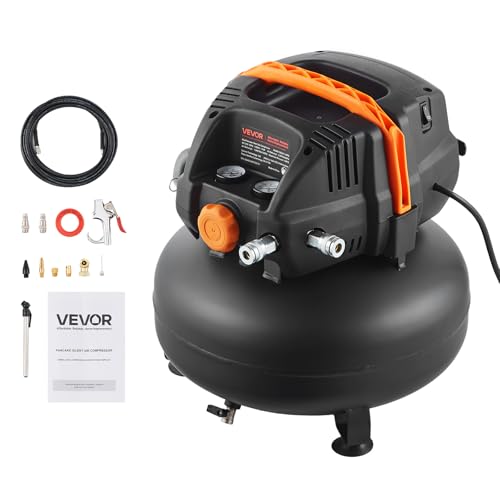
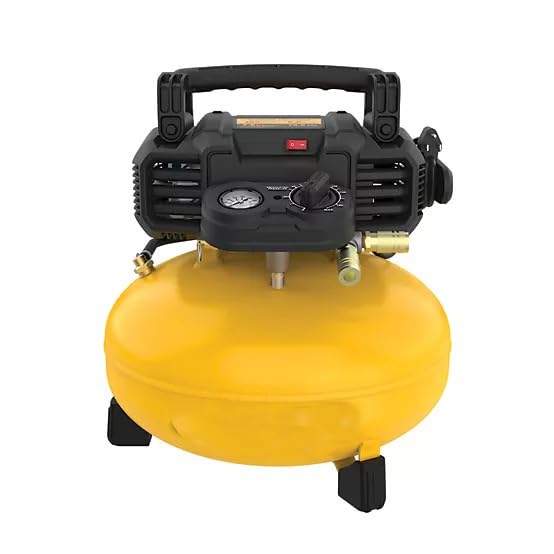
The classic shape for this size is the pancake, a flat round tank that keeps the center of gravity low and stable. Our guide to the best pancake air compressor explains the shape trade offs in more depth. Check the feet as well: wide rubber feet grip a garage floor and damp vibration, while small hard feet let the machine wander and drum on wood floors. A shroud that guards the regulator and gauges pays off the first time the unit tips off a tailgate.
Regulator, Gauges, and Couplers
You set nail depth and tire pressure at the regulator, so a large knob you can turn with gloves and a gauge that reads clearly at a glance are daily quality details. Two gauges, one for tank pressure and one for regulated pressure, are standard and worth having. Universal couplers that accept common plug styles save you from swapping fittings between tools. Push button or quarter turn drain valves are easier to live with than the small wing style valves that seize up after a wet season.
What a 6 Gallon Tank Can and Cannot Run
This size shines with intermittent tools. Brad nailers, finish nailers, staple guns, and inflation nozzles all use short bursts, and the tank refills between shots. A framing nailer works for one person framing at a DIY pace, though the pump will cycle often. The limits appear with tools that draw air continuously. An impact wrench can break loose a lug nut or two on a full tank but will fade during a full wheel swap. Spray painting wants steady airflow this class cannot sustain, and sandblasting or air sanding belongs to compressors with much larger tanks. If inflation is truly your only job, a best cordless air compressor pick is smaller and simpler still.
What Your Budget Buys at This Size
Basic 6 gallon kits start around $100 and often bundle a hose and a starter assortment of fittings, which suits tire and inflator duty. The middle of the range, about $130 to $200, buys faster recovery, better regulators, and sturdier shrouds. Quiet models climb to about $200 to $300, and the premium there is the low noise motor rather than extra air. Spending beyond that rarely makes sense at this tank size; if you need more performance, the smarter move is a bigger tank, not a fancier 6 gallon unit.
Common Mistakes to Avoid
- Judging by horsepower claims instead of SCFM at 90 PSI, which leads to a compressor that cannot keep up with your tools.
- Leaving water in the tank between uses, so rust forms inside and eventually weakens the steel.
- Running the compressor on a long, thin extension cord, which starves the motor and shortens its life.
- Expecting the tank to run a paint sprayer or sander, then blaming the machine for a mismatch it was never sized for.
- Ignoring the decibel rating when the compressor will run in a basement or attached garage, where noise carries into the house.
Care and Maintenance for a 6 Gallon Compressor
Drain the tank after every working day by opening the drain valve and letting the water out while a little pressure remains, since trapped moisture is what rusts tanks from the inside. Store the unit with the drain valve open in damp climates. Check the intake filter every few months and rinse or replace it when it darkens, because a clogged filter makes the pump work longer to fill the same tank. Inspect the hose and couplers for cracks and leaks each season, and test the safety relief valve once or twice a year by pulling its ring briefly with the tank pressurized. Keep the cord wrapped loosely and the unit off cold concrete on a mat or shelf to slow corrosion on the tank feet.
FAQ
What size air compressor do I need for nail guns?
A 6 gallon tank with about 2.5 SCFM at 90 PSI runs brad, finish, and pin nailers comfortably and keeps up with one framing nailer at a relaxed pace. Nail guns use air in bursts, so tank size and recovery speed matter more than huge airflow. If two people will shoot framing nails at once on a crew, step up to a larger tank so the pump is not running constantly.
How long does a 6 gallon air compressor take to fill?
From empty, most models reach full pressure in about 2 to 3 minutes, and recovery from the cut in point takes roughly 30 to 60 seconds. Cold weather and a clogged intake filter stretch both times noticeably. If your unit suddenly takes twice as long as it used to, check the filter and listen for leaks at the fittings before assuming the pump is worn out.
Can a 6 gallon air compressor run an impact wrench?
It can handle short bursts, such as breaking loose a few lug nuts, but it is not the right size for sustained impact wrench work or a full set of wheels. The tank drains quickly under that draw and the small pump cannot recover while you work. For occasional use, fill the tank completely, work in short bursts, and let the pump catch up between fasteners.
How do you drain a 6 gallon air compressor?
Turn the compressor off, pull the relief ring briefly to drop pressure to about 20 PSI, then open the drain valve at the bottom of the tank and let the water run out. Tilting a pancake unit slightly helps the last of the water reach the valve. Do this after each day of use. A valve that drips constantly usually has debris in its seat and often seals again after a few open and close cycles under pressure.
Is a 6 gallon air compressor enough for painting?
For airbrushing and small touch up work with a low volume gun, it can cope in short sessions. For painting panels, fences, or cabinets with a standard HVLP gun, it is not enough, because the gun draws air continuously and pressure at the tip sags as the tank empties, which ruins the finish. Painting regularly is a clear reason to move to a 20 or 30 gallon compressor instead.
Final Thoughts
Six gallons is not a compromise size; it is the size that matches how most homes actually use air. Match the SCFM rating to your hungriest tool, pick the noise level your space can tolerate, and drain the tank like you mean it. Choose well and the best 6 gallon air compressor for your bench will start every project without drama for years. The product table above lines up the contenders so you can compare recovery times and decibel ratings at a glance.


