
8 Best 12 Sliding Miter Saws 2026 - Detailed Buyer Guide & Top Model Analysis
Disclosure: We may earn a commission when you buy through links on this page, at no extra cost to you. As an Amazon Associate I earn from qualifying purchases. Learn more

Whether you are trimming crown molding, framing an outdoor deck, building custom cabinetry, or managing structural upgrades around your home workshop, finding the Best 12 Sliding Miter Saws is essential for ensuring clean joints and rapid, repeatable cuts. A high-grade 12-inch sliding compound miter saw provides unmatched crosscut width and bevel versatility compared to standard fixed saws, allowing you to slice through wide dimensional lumber and tall vertical trim in a single pass. In this 2026 comprehensive guide, we evaluated 8 top-tier models to assist you in selecting the ideal saw for your project scope and workspace layout.
Modern miter saws have evolved significantly, integrating advanced LED shadow alignment lines, high-torque direct-drive motors, space-saving forward rail systems, and even cordless battery platforms capable of hundreds of cuts on a single charge. Choosing the right tool requires balancing motor power, dust extraction performance, bevel range, and table stability. To help complete your workshop setup alongside other outdoor maintenance gear, check out our comprehensive garden tools and workshop equipment catalog for reliable recommendations.



Best 12 Sliding Miter Saws Buying Guide
Investing in a heavy-duty miter saw is a major decision for any serious DIYer, carpenter, or home improvement enthusiast. Saws in this class represent serious machinery capable of cutting wide boards and complex compound angles. Below are the key technical and ergonomic factors you must examine before choosing the right tool for your workshop.
1. Motor Power, RPM, and Drive Mechanisms
The beating heart of any sliding compound miter saw is its motor. For a 12-inch blade, a robust 15-amp motor operating at 120 volts is the industry standard for corded models. These motors generally deliver no-load speeds ranging between 3,800 RPM and 5,000 RPM. Higher rotational speed yields cleaner, tear-out-free cuts in delicate moldings and dense hardwoods like oak, maple, and walnut. When evaluating motors, pay close attention to whether the tool uses a traditional belt-driven transmission or an innovative direct-drive gear system. Direct-drive configurations deliver power straight to the blade with zero belt slippage and allow for a more compact gearbox geometry, which increases vertical cut clearance.
For cordless units, brushless motor technology paired with high-capacity battery packs has closed the performance gap with corded options. Advanced brushless systems optimize energy draw through electronic speed regulation and regenerative braking, slowing the heavy 12-inch blade down quickly while returning small amounts of energy back to the system. If you often work on job sites or remote outdoor locations without immediate access to wall outlets, a cordless 12-inch unit offers massive mobility advantages without sacrificing raw cutting muscle.
2. Crosscut Capacity and Rail Geometry
The primary advantage of a sliding miter saw over a stationary chop saw is its extended horizontal cutting reach. By mounting the motor and blade assembly on linear steel rails, the saw head travels horizontally across the workpiece before or during the chop stroke. Standard 12-inch sliding saws routinely handle 2x14 dimensional lumber at a 90-degree crosscut and 2x10 lumber at a 45-degree miter. Furthermore, tall sliding fence assemblies provide the necessary vertical backstop to nest up to 7-1/2 inches or 8 inches of decorative crown molding vertically, as well as over 6-1/2 inches of standing baseboard.
However, traditional sliding rail systems extend significantly out the rear of the machine, requiring a substantial footprint that prevents the saw from sitting flush against a garage or shed wall. If your workshop space is tight, look for innovative rail geometries such as forward-facing fixed rail designs or compact axial-glide linkages. These configurations keep the sliding mechanism enclosed within the front or fixed tracks, allowing you to mount the tool directly against a back wall without sacrificing a single inch of crosscut capacity.
3. Dual Bevel vs. Single Bevel Versatility
Beveling refers to tilting the saw blade relative to the horizontal table base, distinct from mitering, which pivots the blade horizontally across the fence. Single-bevel miter saws can only tilt to the left, forcing you to manually flip long, awkward boards end-for-end when cutting complementary compound angles for crown molding or framing joints. Dual-bevel saws, on the other hand, tilt both left and right (commonly up to 45, 48, or 49 degrees). This capability saves time, keeps the finished face of your material facing upward for accurate marking, and reduces measuring mistakes.
Look for machines with oversized, high-visibility bevel scales and front-located bevel lock controls. Reaching behind a heavy 12-inch motor assembly to loosen a rear clamping knob can be cumbersome, so front-mounted bevel locks and positive stop overrides significantly enhance workflow speed and physical safety.
4. Alignment Accuracy: LED Shadow Systems vs. Laser Markers
Precision is paramount when constructing tight-fitting joints. Manufacturers employ two main alignment systems: laser guides and LED shadow line systems. Laser markers project a red or green line onto the timber surface. While helpful, lasers often require manual calibration when swapping between thin-kerf and standard-kerf blades, and their visibility can wash out under bright outdoor daylight.
In contrast, LED cutline shadow systems position ultra-bright LED lights on either side of the saw blade. The light casts the actual shadow of the spinning blade directly onto the wood surface. Because this system tracks the real physical kerf of the mounted blade, it never requires recalibration, remains clear in both dim workshops and sunny yards, and provides exact visual indication of where the cut will land on both edges of the blade path.
5. Dust Collection and Workshop Health
A 12-inch blade spinning at thousands of revolutions per minute generates immense quantities of fine airborne sawdust, particularly when working with MDF trim, composite decking, and treated dimensional lumber. Standard fabric dust bags capture only a modest fraction of large chips, leaving fine particulates in the air. High-performance sliding saws feature re-engineered internal dust chutes, rubber deflector shrouds, and dual extraction ports that capture between 75% and 97% of generated dust when connected to an external workshop vacuum or dust extractor.
When selecting a saw, check the dust port diameter for universal compatibility with 1-1/4 inch, 1-7/8 inch, or 2-1/2 inch vacuum hoses. Saws equipped with integrated wireless tool activation allow your dust extractor to automatically power on the moment you pull the saw trigger, keeping your workspace clean with zero extra steps. If you are setting up a comprehensive home fabrication or gardening station, explore our garden tools and hardware guide for auxiliary workshop maintenance gear.
6. Miter Plate Detents and Base Construction
The foundation of cutting accuracy lies in the miter detent plate and table casting. Heavy-duty die-cast aluminum bases offer the optimal blend of rigidity, thermal dissipation, and manageable weight for transport. The miter scale should feature a precision-machined stainless steel detent plate with positive stops at the most critical angles (0°, 15°, 22.5°, 31.62° for crown, and 45° in both directions). A smooth cam-lock miter handle combined with a quick detent override button allows you to bypass preset stops effortlessly when dialing in fractional angles for out-of-square walls.
| Feature Category | Entry / DIY Standard | Mid-Range Workshop | Professional / Heavy Duty |
|---|---|---|---|
| Motor Output | 15-Amp / 3,200 - 3,800 RPM | 15-Amp / 3,800 - 4,800 RPM | 15-Amp Direct Drive or Brushless 20V/FLEXVOLT |
| Max 90° Crosscut | Up to 2x10 or 2x12 | Up to 2x12 or 2x14 | Full 2x14 to 15-inch crosscut |
| Bevel Capability | Single Bevel (0° to 45° L) | Dual Bevel (0° to 45° L/R) | Dual Bevel with micro-adjust (0° to 49° L/R) |
| Cutline Indicator | Red Laser Guide | Laser or Basic LED | XPS Blade Shadow Cutline System |
| Dust Collection | Basic Bag (30% - 50%) | Chute + Bag (60% - 75%) | Dual Port / Shroud Extraction (75% - 97%) |
Our Research Methodology & Why You Can Trust Us
Our evaluation process is built upon unbiased, data-driven analysis and rigorous comparative research. We scrutinized 8 leading miter saw models across $190–$981, gathering data from detailed engineering schematics, certified manufacturer testing standards, precision tolerances, and thousands of real-world user feedback reports. We prioritize machines from trusted power tool brands such as EVOLUTION, VEVOR, and DOVAMAN and other established names known for long-term reliability and accessible customer service.
We specifically examine real-world performance indicators: deflection of the sliding arm under load, table flatness, fence perpendicularity out of the box, dust extraction efficiency under heavy cuts, and ease of bevel adjustments. Our recommendations do not rely on sponsored placements or marketing claims; instead, we analyze how each tool performs across framing lumber, delicate moldings, composite decking, and sheet goods. We update this guide every October 2026 to ensure all specifications, technical updates, and model variations reflect the most current tool releases on the market.
Final Thoughts
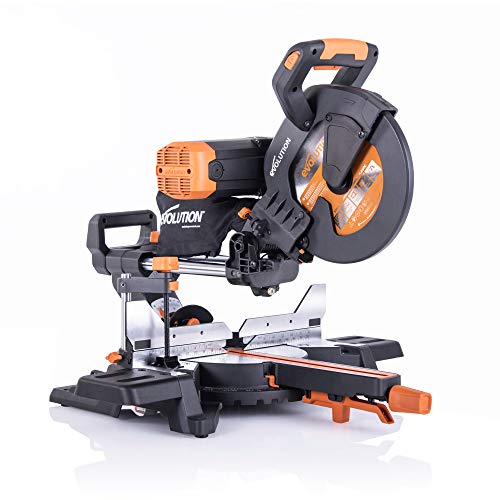
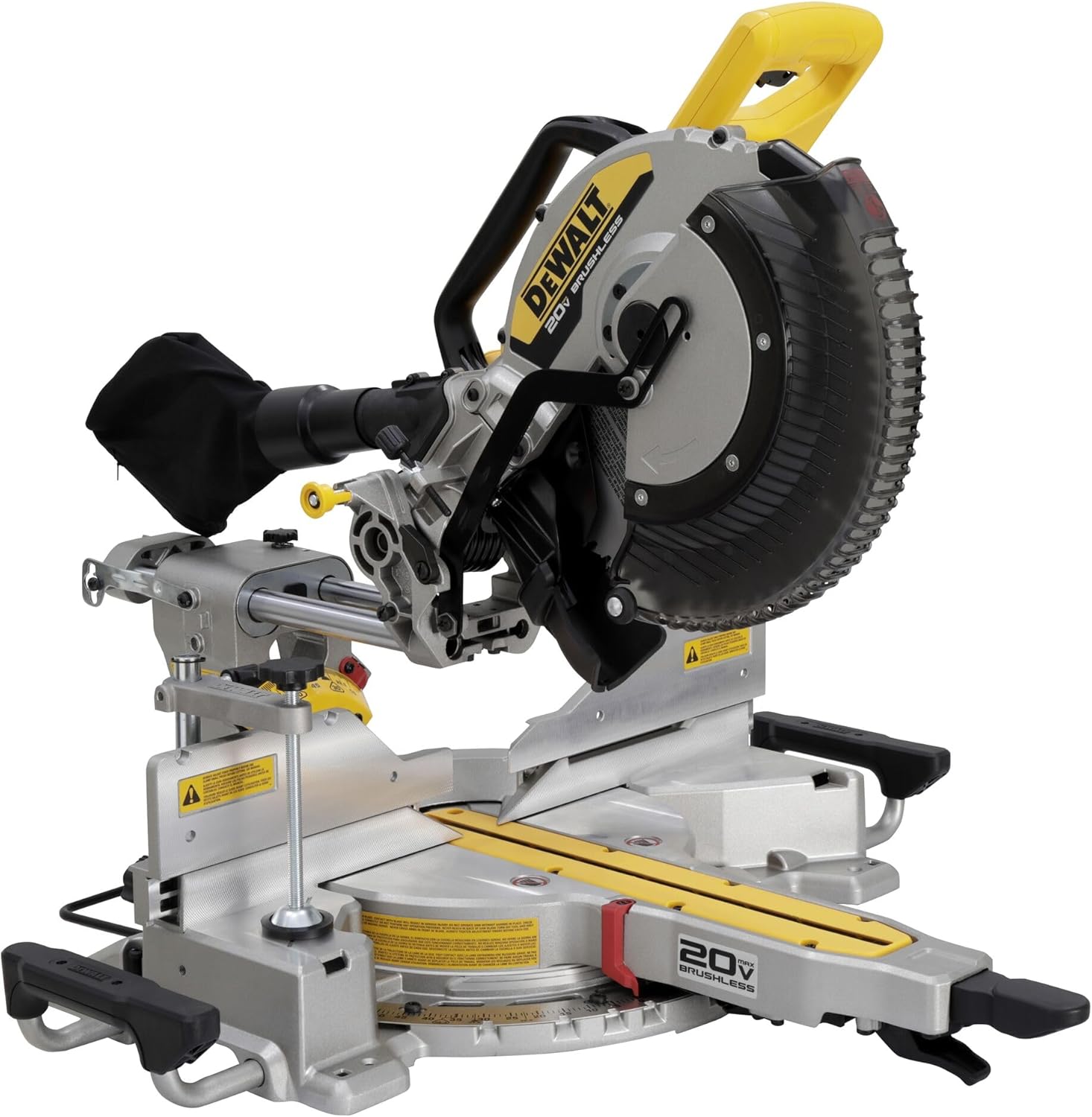
Choosing the Best 12 Sliding Miter Saws comes down to matching your primary project demands with the right balance of cutting capacity, alignment accuracy, and workspace footprint. For a reliable, heavy-duty workhorse that handles everything from rough framing to delicate crown molding, the DEWALT Miter Saw, 12-inch Double Bevel Sliding remains a gold standard thanks to its XPS LED shadow light system, robust 15-amp motor, and expansive 2x14 crosscut capacity. If you need one blade that also cuts mild steel, plastic, and composite decking, the Evolution R255SMS-DB+ 10-Inch Sliding Miter Saw delivers exceptional value with 45-degree dual bevels, 50-degree miters, and a 3-year warranty.
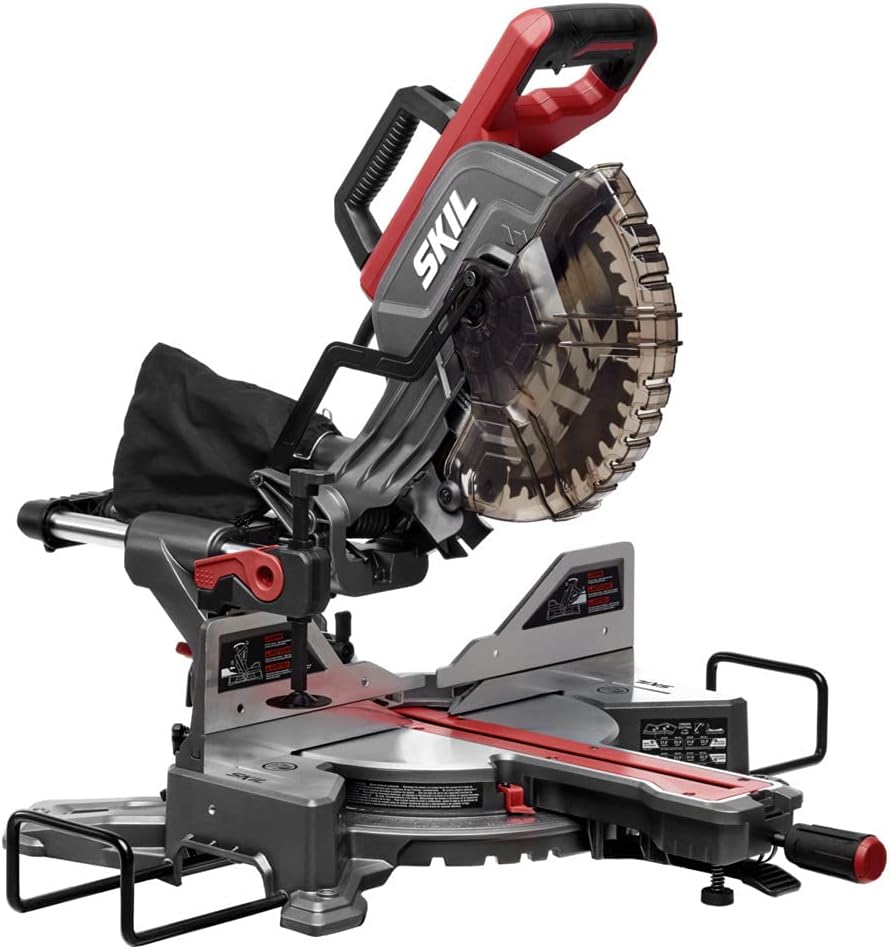
For fine woodworkers and cabinetmakers working in compact workshops, the Makita LS1219L 12" Dual-Bevel Sliding Compound stands out with its direct-drive motor and forward-rail design that sits completely flush against a back wall. If off-grid flexibility and job site mobility are your top priorities, the DEWALT 20V MAX XR 12 inch Double Bevel Sliding provides cordless freedom, regenerative braking, and up to 97% dust capture. Meanwhile, home DIYers seeking capable dual-bevel functionality on a sensible budget should consider the DOVAMAN 12-Inch Dual-Bevel Sliding Compound Miter or the compact SKIL 10" Dual Bevel Sliding Compound Miter.
Whichever saw fits your workflow, always ensure your blade is square to the fence and table before your first cut, and pair your tool with adequate dust extraction and personal protective gear. For more guides and equipment reviews to expand your home workspace, browse our complete garden tools and outdoor workshop resource hub.
Frequently Asked Questions
What is the main difference between a 10-inch and a 12-inch sliding miter saw?
A 12-inch sliding miter saw offers significantly larger cutting capacities in both horizontal crosscuts and vertical heights. While a 10-inch model excels in portability and uses less expensive blades, a 12-inch saw can easily cut through 2x14 lumber at 90 degrees and support up to 7-1/2 inches of nested crown molding against the fence. The larger blade also handles thicker timbers like 4x4 posts in a single, smooth pass without requiring you to flip the board over.
Why do woodworkers prefer an LED shadow line over a laser marker?
LED shadow systems project the physical shadow of the blade directly onto the wood, accurately representing the exact width of the kerf. Unlike lasers, shadow lines never need recalibration after a blade change or tool drop, and they remain clearly visible in both brightly lit rooms and outdoor sun. This makes LED shadow lighting far more reliable for precision joinery.
Can I use a 10-inch blade on a 12-inch sliding miter saw?
While a 10-inch blade may physically fit onto a 12-inch saw if the arbor size matches (typically 1 inch on 12-inch saws, compared to 5/8 inch on 10-inch saws), it is not recommended. Using a smaller blade reduces your vertical cut height, decreases maximum crosscut capacity, and can prevent the blade from fully clearing the throat plate at the bottom of the stroke.
How often should I calibrate my miter and bevel detent angles?
You should always verify calibration straight out of the box before your first project, as shipping vibrations can cause minor misalignments. After initial setup, checking table squareness and bevel accuracy every few months, or immediately after transporting the saw between job sites, ensures your cuts remain true.
What safety precautions are most critical when operating a sliding miter saw?
Always secure workpieces firmly against the fence using material clamps, keep hands outside the marked no-hands zone (at least 6 inches from the blade), and wear ANSI-approved eye and ear protection. Additionally, ensure the blade reaches full operating speed before entering the cut, and wait for the blade to come to a complete stop before lifting the saw head. For additional safety tips across outdoor power equipment, visit our garden tools and power equipment safety hub.


